
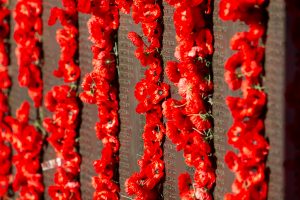
(Photo by Troy Mortier on Unsplash.)
Every one of us has some talent. Most of us work hard. But there’s one thing that will shape our future more than either of those. And we have far less control over it than we think.
In January 1916 the call went out for Army recruits, and when the Northern NSW town of Grafton heard the call, 27 of their strongest young men set out on foot, bound for Sydney. By the time they passed through Coffs Harbour and Port Macquarie, there were over 100 marching.By the time they reached the outskirts of Newcastle, there were 240. And with them, pledges from another 250 to join them within the year. It’s an extraordinary picture. Not just of numbers, but of determination.
Desire to serve alone wasn’t enough; those men needed resilience. For the original group, that meant marching over 600 kilometres on foot before they could even be issued a uniform or a rifle in Sydney. Before they were trained, before they were equipped, before anyone knew they were coming. They walked.
That kind of resilience tells you something about a person. Had they stayed in their communities, they might have been builders, farmers, police officers, firefighters. They had the raw ability to live good, useful lives.
But ability alone is never enough. They also needed training. Talent and skill only goes so far without training. And if you have ever competed for something – an exam, a team, a scholarship – you’ll know. That sometimes it comes down to a choice between you or someone else. And in that moment, we wish we’d done just a little more.
So yes, talent matters. And hard work matters. But there is a third piece we don’t talk about as much: opportunity. You can have all the talent in the world, you can put in all the hard work imaginable, but you’re still bound to unforeseen circumstances. Those North Coast recruits did everything right. They had talent and training, yet they didn’t all survive. Of the 300 thousand Australians who went to the First World War, only a third returned home uninjured. That’s 200 thousand killed or injured in a foreign land. Not because they lacked courage; not because they lacked discipline; but because, through time and chance, they found themselves in a warzone.
And then it happened again, and again over the ensuing century: World War Two, Korea, Vietnam, The Gulf Wars, Afghanistan, and numerous peacekeeping operations in between.
Generation after generation of our most capable. Can you imagine what those men and women might have become if history had been different? Doctors. Engineers. Teachers. Leaders.
It is true that Australia is better for their service. But it is also true that our community paid a price. We lost some of our best. Because sometimes war comes along; other times poverty, prejudice or pandemic. Or it could be as simple as missing the moment.
There’s a line in the Bible that captures this perfectly:
“The race is not to the swift, nor the battle to the strong. But time and chance happen to them all.” (Ecclesiastes 9:11-12)
In other words, success doesn’t always go to the most talented, or the hardest workers. Timing and chance are part of the equation too.
But here’s the thing: because of those who sacrificed, we have opportunities we would otherwise have never had. We’re not marching 600 kilometres to enlist. We’re not being sent across the world into trench warfare. We’re here, with access to education, safety, and possibility. This is not normal in human history.
This is a gift, given to us by someone else who gave up their comfort, their opportunity, their lives – yes, it even cost them descendants – for people like us.
We start to see what real love looks like. They were affected by time and chance, but they used it for our benefit.
Of course, while the Bible may talk about chance, it does so for a human perspective. God has a great plan in mind, and one where sacrifice is the central theme. The Bible speaks about the sacrifice of Jesus Christ, who did not just risk His life for others. He willingly gave it. Not just for one nation, either. Nor just for his friends. Jesus’s sacrifice offers life even to his enemies, through forgiveness and reconciliation, made possible only in the sacrifice of Jesus Christ on the cross.
And the Anzac tradition provides us with a glimpse of that type of sacrifice. Christians understand the value of sacrifice – even the namesake of the faith gave his life for others on the cross – and they may even seek out hardship and difficulty as an opportunity to love their neighbour.
War led many Anzacs to better understand the sacrifice of Christ as well. Presbyterian chaplain Donald Stewart served as chaplain to the frontline 21st Battalion on the Western Front. Speaking at an annual Bible Society branch meeting in Toorak, Melbourne, in 1917, he observed of his brigade and battalion;
“I am perfectly certain that I know of many who have come to clear Christian conviction among these experiences at the front, who probably would not have come so soon or might not have come at all if they had stayed at home.”
Whether you would call yourself a Christian or not, here is the question it raises: If others have given so much, if opportunities have been provided at such a cost, what will you do with the opportunity you have been given?
Take the opportunities in front of you. Because they will not always be there. Make use of your talent, develop good working habits, but also seek out opportunities to use what you have been given, not just for yourself, but for the good of others. Most of all, take the opportunity to know and trust Jesus, who has called you to be with Him. But be careful. For the Christian, there is one more component to a meaningful life: love.
Without love, your opportunites will eventually come to nothing (1 Corinthians 13:1-3). Without love, we risk becoming puffed up by our achievements and our success (1 Corinthians 8:1). And this love does not come from ourselves; it is the gift of God, put on over everything. In ourselves we can do nothing, but by grace alone, it is Christ’s love which powerfully compels us (2 Corinthians 5:14), because:
“he died for all, that those who live should no longer live for themselves but for him who died for them and was raised again.” (2 Corinthians 5:15)
Lest we forget the legacy of the Anzacs; lest we ignore the reference to the ultimate sacrifice, found in Jesus Christ.
[A committee member of the GS&C, Benjamin also serves as an officer of the Royal Australian Air Force. This post is derived from Benjamin’s 2026 speech to an Anzac service at James Ruse Agricultural High School, his alma mater.]