It was a strange experience.
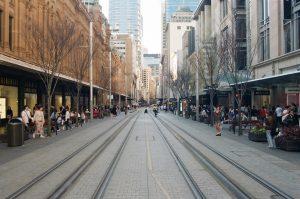
(Photo: Jay Lee via Unsplash)
A few weeks ago I found myself back among the skyscrapers and the crowds of Sydney. I had lived in Sydney for more than 20 years, even working in the CBD for a few years. So I was familiar with the place. And yet, not entirely. I was also a stranger, having lived in a NSW country town for the past 6 years (with a great delight, I might add!).
As I walked down the streets from Wynyard to Town Hall, I felt a bit sentimental. I knew the basic outline of the area, even though George Street looked a bit different. I remembered cars and buses; in their place now, light rail tracks. I remembered the corner where I used to meet up with my cousin, who also worked in the city. I remembered the shops that I had visited.
But along with the mild nostalgia, there was, dare I say, estrangement. It felt as if I was visiting a foreign nation, rather than what I had thought was my home town. Shop signs were written in big Chinese characters – which I can’t read – and such small English letters underneath that I had to walk closer to read. People waited in line, not for coffee, but for their special blend of sweet tea. And the vast majority of people seemed to be of Asian background – like me – which meant I should’ve felt right at home. But, no. It felt odd. Sydney was not what I was used to.
I had heard of the culture shock that missionaries and expats experience upon their return to their home town. Was I experiencing a mild version of that?
Now, there is nothing inherently wrong with shop signs written in another language, or with those tea shops, or with having many Asians walking about in our cities. But these are indications that there have been some changes.
Hot topics
Multiculturalism and immigration is a live topic for discussion in Australia. Not for the first time, of course. They were also hot topics when I first came to Australia as a young teenager about 30 years ago. I am grateful that many public figures laboured to ensure people like me were welcomed and treated fairly. And I am even more grateful for people who were patient with me when I couldn’t speak much English, or when I didn’t understand the cultural norms of this Great Southern Land. I knew I was going to stand out as part of a minority, set apart from a mostly white, English-speaking, majority culture. I was grateful that, although I looked different and spoke funny, most of the people I met didn’t mind having me as a friend, as a colleague, or as a neighbour.
Fast forward to recent years, and it’s been a rather rapid cultural change in Australia. There had been, for many years, “pockets” in Sydney where certain ethnic groups were concentrated. But it was assumed that Australia was a Western country, consisting of mostly white people with Anglo-celtic background. But that’s changing: more non-Anglo people in Australia than 30 years ago; international conflicts and division threaten to divide our nation, or at least raise anxiety. Perhaps our hope of global unity was shattered in the attacks of September 11, 2001, by the subsequent war on terror, or by COVID-19’s disruption. The list continues: we had our internal struggles about national and cultural identity as we debated the Voice to the Parliament. We heard strong criticism locally over the Israel-Gaza war, and then watched in horror the Bondi terror attack.
Meaningful conversation
It looks to me that conversations about multiculturalism and immigration are unavoidable, but also important. We need to be better at having meaningful conversation. It will involve more than merely debating the next government policy. It will require the strength to ask and answer difficult questions around our national and cultural identity. What do we believe about Australia? Do we have a national identity? Or is it just a label on my passport? Is there one Australian culture, that can be expected to be shared, not only between Newtown and Dubbo, but also among the various ethnic groups? These are not easy questions. I don’t have all the answers, either. Yet they are vital questions.
In fact, Christians are well placed to wrestle with these questions, and to come up with answers. As Christians, we hold dual citizenship; part of God’s kingdom, and also citizens of this world. We have an obligation to contribute to this discussion, because that dual citizenship gives us a more objective understanding of the common good. Moreover, we are uniquely equipped to make a valuable contribution to this discussion, since our gospel-shaped worldview takes into account both the beautiful and tragic reality of this world. It overcomes our fear of the future, and potential suspicion of foreigners. Ultimately, when we apply God’s word to multiculturalism and immigration, we can help identify what makes Australia a nation, and help to better love our neighbours, as God requires.
[The Gospel, Society and Culture committee has resources related to the issue of multicultural and multifaith society, for further reading:
The committee is considering more resources. Feel free to have your say by contacting the committee.]